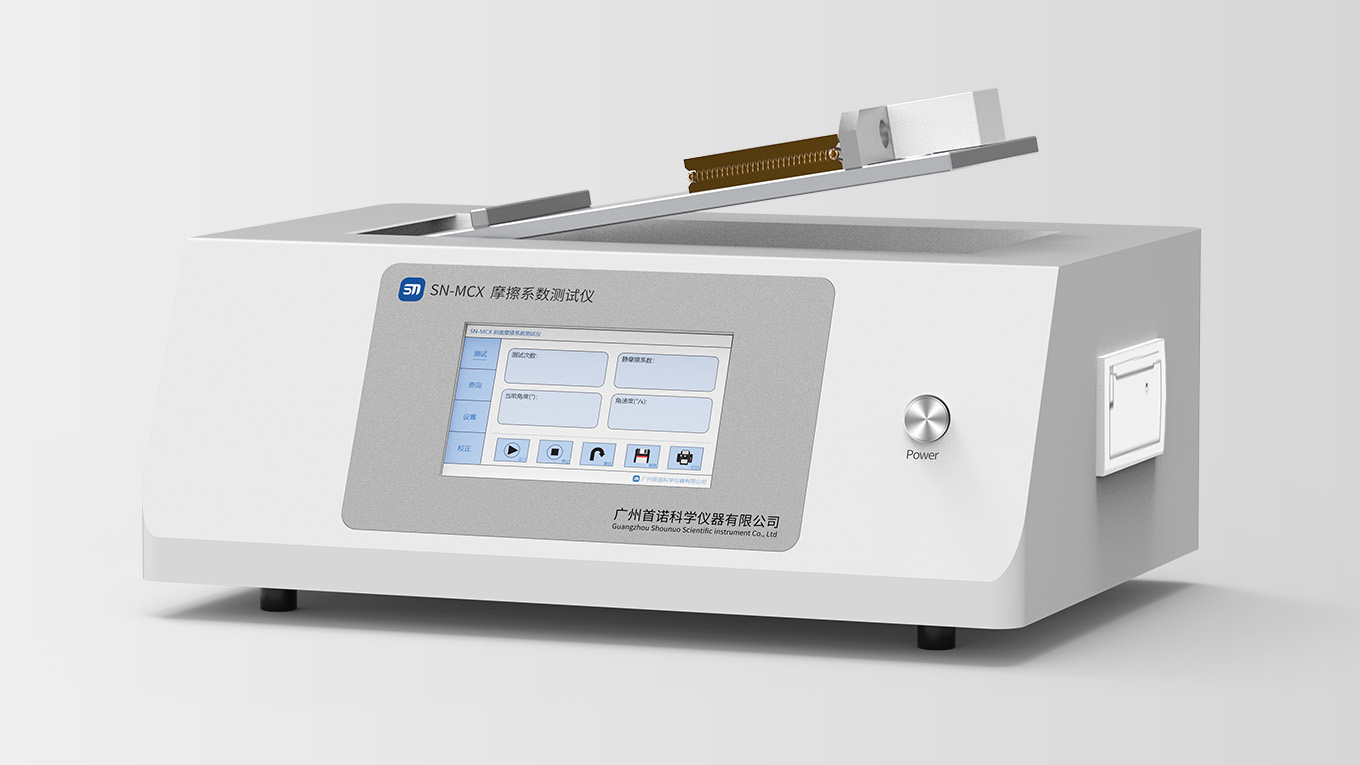
Intended Use:
Uses the inclined-plane sliding method to determine the coefficient of static friction (μs) between material surfaces, evaluating the slip and anti-blocking properties of materials. It provides a quantitative basis for packaging bag opening control, smooth conveying on packaging machines, and stacking stability.
It is designed for friction performance testing of PE, PP, PET monolayer and multilayer composite films, as well as composite films for food and pharmaceutical packaging. It is widely used for evaluating opening performance and packaging speed matching in food flexible packaging, slip control of pharmaceutical blister/composite films, and incoming/outgoing friction performance inspection by quality inspection institutions and film manufacturers.
Operating Principle:
The specimen is laid flat on an inclined plane with an adjustable angle, and a slider (covered with the specimen) is placed on it. The inclined plane is slowly raised at a set angular speed. An angle sensor records the critical angle θ at which the slider begins to slide, and the coefficient of static friction is automatically calculated according to μs = tanθ.
Product Features:
- Steplessly adjustable angular speed (typical range 0.1°/s–10.0°/s), suitable for specimens with different sliding characteristics; the test platform automatically resets, improving efficiency for repeated testing.
- Both the test platform and slider are demagnetized and tested for residual magnetism, reducing magnetic interference on the sliding behavior of lightweight sliders. This is a design detail that distinguishes the inclined-plane tester from general-purpose tensile testers.
- Embedded control, menu-driven interface, smart touchscreen.
- A laser distance sensor accurately captures the instantaneous sliding displacement of the slider. This is more reliable than simple detection based solely on an angle trigger, improving the accuracy of critical angle identification.
- Equipped with a built-in micro-printer and RS232/USB interfaces; optional professional software for curve plotting, data statistics, and report printing.
Standards:
TAPPI T815, ISO 8295, ASTM D202, ASTM D4918, GB/T 10006
Application Fields:
Packaging | Food | Pharmaceuticals | New Materials | Chemical Industry | Printing
Technical Parameters:
Angular Speed
0.1°/s–10.0°/s, steplessly adjustable
Slider Specifications
Standard 1300 g; optional 200 g, 235 g (customizable masses available)
Data Display
Coefficient of static friction, current angle, angular speed
Power Supply / Net Weight
AC 220 V 50 Hz; approx. 20–22 kg
Operating Environment
Temperature 23±2 °C, humidity 20%RH–70%RH.
Sample Preparation
Film specimens must be flat, wrinkle-free, and uncontaminated.
Standard Configuration:
Main unit (including adjustable inclined plane platform, angle control system, and micro printer) 1 unit; 1300 g standard slider 1 pc; power cord; operation manual.
Optional Accessories:
Professional test software (for curve analysis, batch data management, and report output); communication cable (RS232/USB); 235 g slider, 200 g slider; non-standard mass slider (customized); some models can be optionally equipped with a Windows control system or external computer.
User-provided Items:
If software connection is selected, a computer with the corresponding communication interface must be provided by the user; a 220 V power outlet meeting grounding requirements.